June 5, 2010

Christopher Robin Milne

Piglet sidled up to Pooh from behind.
"Pooh," he whispered.
Yes, Piglet?
"Nothing," said Piglet, taking Pooh's paw,
"I just wanted
to be sure of you."


Alan Alexander Milne, son of John Vine Milne and Sarah Maria Heginbotham, was born 18 Jan 1882 in Hampstead, England. He grew up in Kilburn, London at Henley House School, a small independent school run by his father.

He met Dorothy “Daphne” de Selincourt at her coming-out dance. The daughter of Martin Robert Selincourt and Mabel Speed, Daphne was born 1890 in Battersea, England. They married 4 Jun 1913 in Chelsea where their son, Christopher Robin Milne, was born in 1920.

Two years later, Milne wrote a story about a boy named Christopher Robin, named after his son, and various characters inspired by Christopher’s stuffed animals … most notably a bear named Winnie-the-Pooh. Originally named "Edward", the bear was renamed: "Winnie" after a Canadian black bear (Winnipeg) that was used as a military mascot in World War I and left to London Zoo and "Pooh" after a swan called "Pooh". Winnie-the-Pooh was published in 1926, followed by The House at Pooh Corner (1928).

In 1925, the Milne’s bought “Crotchford Farm”, a country home in Hartfield, East Sussex. During World War II, he was Captain of the Home Guard in Hartfield and Forest Row, insisting on being plain 'Mr. Milne' to the members of his platoon. He retired to the farm after a stroke and brain surgery in 1952 left him an invalid and died at Crotchford Farm on 31 Jan 1956. Daphne died in 1971.

Christopher Robin Milne was born 21 Aug 1920 in Chelsea, England and died 20 Apr 1996 in Teignbridge, England. In Jul 1948 he married his cousin, Lesley de Selincourt, daughter of Aubrey de Selincourt and Irene Rutherford McLeod. Lesley was born abt. 1920. Their daughter, Clare Milne, was born in 1956.

About Lesley, Christopher wrote: “Although Lesley had an older sister, a four-year gap and a great difference in temperament lay between them. So, like me, she had led the life of a solitary child and like me she had enjoyed it. We had both of us been brought up in the country, both of us had spent long, happy hours wandering alone through the fields and woods, sitting alone under trees, lying alone in the grass. Like me she preferred animals to humans. Our discovery was that though we were both solitaries we liked being solitary in each other's company. We enjoyed walking together along a country footpath, we enjoyed sitting together on a sofa, we enjoyed lying together beneath a hedge. Together we were yet separate; touching, yet silent; she and I each engaged with our own thoughts—yet lost and lonely now without the presence of the other.”
The Path Through the Trees

About being the muse of “Winnie the Pooh”, he wrote: “So if I seem ill at ease posing as Christopher Robin this is because posing as Christopher Robin does today makes me feel ill at ease. And if I seem to write most happily about the ordinary things that boys do who live in the country it is because this is the part of my childhood that I look back upon with the greatest affection.

It is difficult to say which came first. Did I do something and did my father then write a story around it? Or was it the other way about, and did the story come first? Certainly my father was on the look-out for ideas; but so too was I. He wanted ideas for his stories, I wanted them for my games, and each looked towards the other for inspiration. But in the end it was all the same: the stories became a part of our lives; we lived them, thought them, spoke them. And so, possibly before, but certainly after that particular story, we used to stand on Pooh-sticks Bridge throwing sticks into the water and watching them float away out of sight until they re-emerged on the other side.” –The Enchanted Places

Christopher died on 20 Apr 1996.

His obituary: "Christopher Robin Milne, bookshop owner, died on April 20, 1996 aged 75. He was born on August 21, 1920. Christopher Robin Milne was the reluctant possessor of one of the most evocative Christian names in Britain. Immortalized by his father, the writer A. A. Milne, as the gingham-smocked companion of Winnie the Pooh, he struggled throughout his life to rid himself of the bothersome legacy of his fictionalized childhood. Milne is survived by his wife Lesley, and a daughter who has cerebral palsy."

June 4, 2010

The Ingalls Family

"I am beginning to learn that it is the sweet, simple things of life
which are the real ones after all."


Charles Phillip Ingalls, son of Lansford Whiting Ingalls and Laura Louise Colby, was born 10 Jan 1836 in Cuba, NY and died 8 Jun 1902 in DeSmet, SD. He married Caroline Lake Quiner, daughter of Henry Newton Quiner and Charlotte Wallis Tucker, 1 Feb 1860 in Concord, WI. Caroline was born 12 Dec 1839 in Brookfield, WI and 20 Apr 1923 in DeSmet.

Charles and Caroline made their first home near the village of Pepin in the “Big Woods” of Wisconsin where their daughters, Mary and Laura, were born. Pepin became the setting for Laura’s first book, Little House in the Big Woods. Inspired by the Homestead Act of 1862, which offered 160 acres of “free land” to settlers who would farm and live on it for 5 years, they headed to land located within the boundaries of the Osage Diminished Reserve where they built a home and planted crops.

Carrie Ingalls was born in the summer of 1870. Come fall her parents learned the government had changed their minds about opening the land for homesteading and was sending soldiers to force settlers out. Rather than wait for them to arrive, the family returned to the Big Woods. But it wasn’t long before Charles longed to go west again. So, in 1874, they traded for a small preemption claim in Walnut Grove, Minnesota where the family lived in a creek bank dugout until Charles could build their home. In Nov 1875 their son “Freddy” was born.

After grasshoppers invaded the area and destroyed their crops, they traveled to an uncle’s farm in South Troy, Minnesota where Charles helped with the harvesting. While there, Freddy became ill and died. Saddened by the loss of their son, the Ingalls moved on to Burr Oak, Iowa where a friend had purchased a hotel. The Ingalls lived in the hotel and helped manage it, but did not like the work. They moved first to some rented rooms over a grocery and then to a little brick house outside of town, where their daughter Grace was born in May 1877.

Homesick for their friends, they returned to Walnut Grove in the summer of 1877. Charles served as the town butcher and Justice of the Peace. In 1879, their daughter Mary suffered a stroke and lost her eyesight. That same year the Ingalls family made their final move when Charles was offered a job as a railroad manager in Dakota Territory.

When the railway work moved on, the Ingalls family stayed and, together with friends, became the first residents of the new town of DeSmet and watched the town rise up from the prairie in 1880.

Children of Charles and Caroline Ingalls:

Mary Amelia Ingalls was born 10 Jan 1865 near the village of Pepin in the Big Woods of Wisconsin and died 17 Oct 1928 while visiting her sister Carrie in Keystone, SD. At the age of 14, Mary had a stroke that resulted in blindness. Her sister Laura became “eyes for Mary”, describing everything she saw for her blind sister. In late 1881, the family had saved up enough money to send Mary to the Iowa School for the Blind in Vinton, Iowa.

Laura Elizabeth Ingalls was also born near the village of Pepin on 7 Feb 1867 and died in her sleep on 10 Feb 1957 at “Rocky Ridge Farm” in Mansfield, MO. She attended school in DeSmet, where she met homesteader Almanzo James “Manly” Wilder, son of James Wilder and Angeline Albina Day. Almanzo was born 13 Feb 1857 in Malone, NY and died at Rocky Ridge Farm on 23 Oct 1949.

At the age of 15, Laura earned her teaching certificate and was hired by the Bouchie School. She stopped teaching when she married Almanzo on 25 Aug 1885 in DeSmet. Their daughter Rose was born 5 Dec 1886. Their second child, a boy, died unnamed soon after his birth in Aug 1889.

The first few years of marriage held many trials. Complications from a life-threatening bout of diphtheria left Almanzo partially paralyzed. While he eventually regained nearly full use of his legs, he needed a cane to walk for the remainder of his life. The tales of their trials at farming can be found in The First Four Years (1971), a manuscript that was discovered after Rose’s death.

In 1930, Laura asked her daughter’s opinion about a biographical manuscript she had written about her pioneering childhood. The Great Depression, coupled with the death of her mother in 1924 and sister Mary in 1928, seem to have prompted her to preserve her memories in a life story. The title of the first of her books was When Grandma Was a Little Girl, later titled Little House in the Big Woods (1932). Other books include:
  • Farmer Boy (1932) -- About Almanzo’s childhood on a farm in New York.
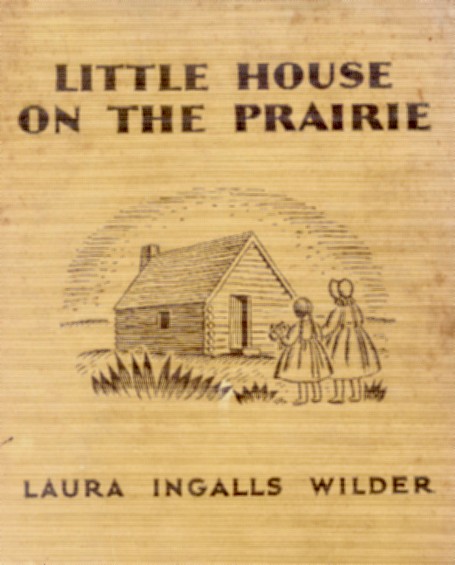
  • Little House on the Prairie (1935)
  • On the Banks of Plum Creek (1937)
  • By the Shores of Silver Lake (1939)
  • The Long Winter (1940) -- Describes one of the most severe winters on record in the Dakotas.
  • Little Town on the Prairie (1941)
  • These Happy Golden Years (1943)
  • On the Way Home (1962) -- A diary of the Wilders’ move from DeSmet to Mansfield.
  • The First Four Years (1971)
  • West From Home (1974) -- Laura’s letters to Almanzo during a 1915 visit to their daughter Rose in San Francisco.
  • The Road Back (Part of A Little House Traveler: Writings from Laura Ingalls Wilder’s Journeys Across America) – Previously unpublished record of a 1931 trip with Almanzo to DeSmet and the Black Hills.

Caroline Celestia “Carrie” Ingalls was born was born 3 Aug 1870 in Montgomery Co., KS and died of a sudden illness on 2 Jun 1946 in Pennington Co., SD. She married mine owner David N. Swanzey, a widower with two young children, on 1 Aug 1912. David was born in 1854 and died in Apr 1938.

They lived in Keystone, SD … the site of Mt. Rushmore. When Gutzon Borglum arrived in the area looking for a good site for the carving, David was one of a group of men who recommended the mountain and led the sculptor to it. His son helped with the carving.

Charles Frederic “Freddy” Ingalls was born 1 Nov 1875 in Walnut Grove, MN. The following summer, the family traveled to an uncle’s farm near South Troy, MN where Freddy died on 27 Aug 1876.
Grace Pearl Ingalls was born 23 May 1877 in Burr Oak, IO and died 10 Nov 1941 in DeSmet, SD.

Like her sister Laura, Grace became a teacher. She met Nathan William Dow while teaching in Manchester, SD and married him in DeSmet on 16 Oct 1901. He was born in 1859 and died in DeSmet in 1943.

They lived in Manchester until the death of Grace’s mother, after which they returned to DeSmet to care for her sister Mary. A diary kept during her girlhood years was published in William Anderson’s booklet, The Story of the Ingalls.

June 3, 2010

The Lofft Family

"Ted and Nina are two little children
just like you.
Ted is four years old.
Ted wears a striped jersey.
He goes to kindergarten.
Nina is six years old.
Nina wears a plaid skirt.
She goes to school.
Tippy, the little dog, is just a puppy.
Tippy goes everywhere that he shouldn't.
He wears a little tail and a happy look."


Shadrach George Lofft, son of William Lofft and Margaret Sloan, was born 22 Mar 1865 in Lapeer, MI and died 17 Jan 1937 in Collingswood, NJ. He married Ruby Adele Tuttle, daughter of Columbus Tuttle and Eunice Hough, 30 Nov 1886 in Lapeer. She was born there 28 Sep 1867 and died 5 Jul 1958 in Collingswood.

In addition to his profession of photography, Shadrach was an illustrator who loved to draw pastel and crayon portraits. Unable to support his family as a photographer, the family moved in 1902 to Philadelphia where he worked for a Dry Plate company.

Children of Shadrach and Ruby Lofft:

Nina Eunice Lofft was born 3 Dec 1887 in Lapeer, MI and died 3 Apr 1918 in Collingswood, NJ. She married Horace K. Price.

Marguerite Ethel Lofft was born 14 Mar 1889 in Lapeer and died 17 Jun 1987 in Philadelphia, PA. She entered high school in 1904, but a year later began to sing professionally as a contralto in a Presbyterian choir and soon withdrew from high school for more musical training.

She met John Dailey “Dai” de Angeli, a violinist, in 1908 and married him Apr 1910 in Toronto, Canada. After living in many locations in the American and Canadian West, they settled in a suburb of Collingswood, NJ. There, in 1921, Marguerite started to study drawing under her mentor Maurice Bower. The following year, she began illustrating a Sunday school paper and was soon doing illustrations for magazines such as The Country Gentleman, Ladies’ Home Journal and The American Girl.

Her first book, Ted and Nina Go to the Grocery Store, was published in 1935 and featured her siblings as its main characters. It was followed by Ted and Nina Have a Happy Day (1936) and a Summer Day With Ted and Nina (1940).

You can read the Ted and Nina series online at http://www.deangeli.lapeer.org/Ted-Nina/index.html.

Other books in which her family members are characters include: Copper-Toed Boots (1938), a portrayal of the mid-nineteenth century rural life of her father in Lapeer, MI; Turkey for Christmas (1944), a semi-autobiographical account describing her family’s first Christmas in Philadelphia after moving there in 1902; and Fiddlestrings (1974), based on the boyhood of her husband Dai in the 1890s.

Dai was born 10 Apr 1880 in Toronto. He died 8 month before their 60th wedding anniversary on 18 Jul 1969. Two years after his death, Marguerite published her first autobiography, Butter at the Old Price (1971). Her last work, Friendship and Other Poems (1981) was published when she was 92 years old. During her lifetime, Marguerite wrote and illustrated 28 books and illustrated more than three dozen books and numerous magazine stories and articles for other authors. Her own work explored and depicted the traditions and rich cultural diversity of common people more frequently overlooked.

William Arthur Lofft was born 4 Jun 1894 in Lapeer and died in 1965.


June 2, 2010

The Farjeon Children

"So terrified was he of being caught, by chance, in a false statement, that as a small boy he acquired the habit of adding 'perhaps' to everything he said."

Benjamin Leopold Farjeon, son of Jacob Farjeon and Dinah Levy, was born 12 May 1838 in London, England and raised in Whitechapel. At the age of 14, having no formal education, he entered the office of the Nonconformist, a Christian journal to learn the printing trade. In 1854, he broke away from the strict Jewish Orthodox faith of his father and immigrated to Australia. During the voyage he was moved from steerage to cabin class because he had produced many issues of a ship newspaper, the "Ocean Record".

He worked as a gold miner in Victoria, Australia, started a newspaper and then, in 1861, went to New Zealand where he settled at Dunedin, working as a journalist on the Otago Daily Times. He soon became manager and sub-editor and began writing novels and plays. He attracted the attention of Charles Dickens and, in 1868, returned to England where he lived in the Adelphi Theater. Over the next 35 years, he produced nearly 60 novels.

He married Margaret Jane "Maggie" Jefferson, daughter of the American actor Joseph Jefferson (shown left) and Margaret C. Lockyer, 6 Jun 1877 in London. She was born 3 Jul 1853 in Manhattan, NY and died 1933 in London, England. Benjamin died there on 23 Jul 1903.

Children of Benjamin and Margaret Farjeaon:

Harry Farjeon was born 6 May 1878 in England and died 29 Dec 1948 in Hampstead, England. Harry composed music throughout most of his life. His compositions are mostly for piano, but he also wrote songs, sonatas, concertos and a mass setting.

In 1942 his symphonic poem Pannychis, with words by his sister, was played at a Promenade Concert, conducted by Basil Cameron. He regarded the symphonic poem Summer Vision as his best work, but the score was sent to Germany shortly before World War I and was lost.

His eyesight had been bad since childhood, and it grew worse as he became older. His students wrote their compositions on specially printed brown paper. Steve Race has said that writing on this paper cured him of writing long rambling compositions. Farjeon taught at the Academy for forty-seven years, despite developing Parkinson's disease in later life. He was still teaching thirty students a week when, at the end of the July 1948 term, he fell and broke his hip.

Eleanor Farjeon was born 13 Feb 1881 in England and died there 5 Jun 1965. Known to the family as “Nellie”, Eleanor was a timid girl who had poor eyesight and suffered from ill health throughout her childhood. She was educated at home where her father encouraged her writing from the age of five. She describes her family and her childhood in A Nursery in the Nineties (1935). (Portrait of a Family was its American title.)

Although she lived much of her life among the literary and theatrical circles of London, much of Eleanor's inspiration came from her childhood and from family holidays. A holiday in France in 1907 was to inspire her to create a story of a troubadour, later refashioned as the wandering minstrel of her most famous book, Martin Pippin in the Apple Orchard. During World War I, the family moved to Sussex where the landscape, villages and local traditions were to have a profound effect upon her later writing. It was in Sussex that the Martin Pippin stories were eventually to be located.

At eighteen Eleanor, wrote the libretto for an operetta, Floretta, to music by her brother Harry who later became a composer and music teacher. She also collaborated with her brother Herbert, a Shakespearian scholar and dramatic critic. Their productions include Kings and Queens (1932), The Two Bouquets (1938), An Elephant in Arcady (1939), and The Glass Slipper (1944). After World War I, Eleanor earned a living as a poet, journalist and broadcaster. Often published under a pseudonym, Eleanor's poems appeared in a number of periodicals. Her topical work for The Herald, Reynolds News and New Leader was the perhaps the most accomplished of any socialist poet of the 1920s and 30s.

These days, Eleanor Farjeon's most widely known work is the popular children's hymn Morning Has Broken, written in 1931 for an old Gaelic tune associated with the Scottish village Bunessan. It was later popularized by Cat Stevens. Her other hymn is the Advent carol People, Look East, usually sung to an old French melody, and a favorite with children's choirs. Morning has Broken is one of the many poems to be found in the anthology Children's Bells under its correct title A Morning Song (For the First Day of Spring), published by Oxford University Press in 1957 and bringing together poems from many sources, including the Martin Pippin books.

Eleanor never married but had a 30-year friendship with George Earle, an English teacher. After his death in 1949, she had a long friendship with actor Dennys Blacklock, who wrote of it in Eleanor, Portrait of a Farjeon (1966).

Joseph Jefferson Farjeon was born 4 Jun 1883 in England and died WHEN in England. Joseph was a novelist.

Herbert Farjeon was born 5 Mar 1886 in England and died 1945 in England. His first play to be performed, Friends, was put on at the Abbey Theatre, Dublin in 1917. Subsequently he had several plays performed in London. He was better known for his reviews than for his "straight" plays which included: Spread It Abroad, The Two Bouquets, Nine Sharp, Little Revue, Diversion and Light and Shade. He is credited with discovering Joyce Grenfell, whose first stage appearance was in Light and Shade. In 1938, he joined the management of the Little Theatre in London, and his revues were performed there. His songs included I've danced with a man, who's danced with a girl, who's danced with the Prince of Wales.

He was interested in the history of the theatre, and wrote about the Elizabethan theatre, Shakespeare and his plays, and edited a seven volume publication of the text of the First Folio. In the 1940s he helped to save the Theatre Royal, Bristol when it was put up for sale and might have ceased to be a theatre.

He also collaborated with his sister on a number of books, including Kings and Queens (1932), The Two Bouquets (1938), An Elephant in Arcady (1939) and The Glass Slipper (1944).

June 1, 2010

Edith Bratt Tolkien

"But wandering in the summer in the woods of Neldoreth Beren came upon Luthien, daughter of Thingol and Melian, at a time of evening under moonrise, as she danced upon the unfading grass in the glades beside Esgalduin. Then all memory of his pain departed from him, and he fell into an enchantment; for Luthien was the most beautiful of all the children of Iluvatar."

Arthur Reuel Tolkien, son of John Benjamin Tolkien and Mary Jane Stow, was born Feb 1857 in Handsworth, Staffordshire, England. He did not follow his father into the traditional Tolkien trade in pianos, which many of his London cousins did; instead he became a bank clerk and moved to Bloemfontein in the Orange Free State (now part of South Africa), where he became manager of the Bloemfontein branch of the Bank of Africa. He was later joined by his fiancée, Mabel Suffield, daughter of John Suffield and Emily Jane Sparrow. Mabel was born Jan 1870 in Birmingham, England.

They married in Cape Town, South Africa on 16 Apr 1891. After the birth of their two children, John Ronald Reuel (3 Jan 1892) and Hilary Arthur Reuel (17 Feb 1894), Mabel felt the English climate would be better for the boys' health and returned to England with them in 1895. Arthur remained in Bloemfontein, where he died of severe hemorrhage, following rheumatic fever, on 15 Feb 1896. His death left Mabel and their children without a source of income. At first, they lived with her parents in Birmingham and then moved to Sarehole (now in Hall Green), a Worcestershire village.

Mabel tutored her two sons, and J.R.R. (or Tolkien, as he was known in the family) was a keen pupil. She taught him a great deal of botany and awakened in her son the enjoyment of the look and feel of plants. But his favorite lessons were those concerning languages, and his mother taught him the rudiments of Latin very early. She also taught him how to write, and her ornate script influenced her son's handwriting in his later life.

Mabel Tolkien died of acute complications of diabetes on 14 Nov 1904 at "Fern Cottage" in Rednal (where they were renting). She was about 34 years of age, which was about as long as a person with diabetes mellitus type 1 could live with no treatment (insulin would not be discovered until two decades later). For the rest of his life Tolkien felt that his mother had become a martyr for her faith, which had a profound effect on his own Catholic beliefs.

John Tolkien Reuel Tolkien married Edith Mary Bratt, daughter of WHO and WHO. She was born 21 Jan 1889 in Glouchestershire, England. By 1908 Edith, a talented pianist, had become an orphan. She first met Tolkien that year, when he and his brother moved into the same boarding house. At the time, Tolkien was 16 years old and Edith was 19.

According to Humphrey Carpenter, "Edith and Tolkien took to frequenting Birmingham teashops, especially one which had a balcony overlooking the pavement. There they would sit and throw sugar lumps into the hats of passers-by, moving to the next table when the sugar bowl was empty. With two people of their personalities and in their position, romance was bound to flourish. Both were orphans in need of affection, and they found that they could give it to each other. During the summer of 1909, they decided that they were in love."

Before the end of the year the relationship had become known to Tolkien’s guardian, Fr. Francis Xavier Morgan of the Birmingham Oratory. Viewing Edith as a distraction from Tolkien’s schoolwork and bothered by her Anglican religion, he forbade any contact between them until Tolkien became a legal adult at 21. Tolkien grudgingly obeyed this instruction to the letter while Father Morgan's guardianship lasted. However on the evening of his 21st birthday, Tolkien wrote a letter to Edith, who had since moved to Cheltenham. It contained a declaration of his love and asked her to marry him. She replied saying that she was already engaged but subtly implied that she had become so out of a belief that Tolkien had forgotten her. Within a week, Tolkien had journeyed to Cheltenham where Edith met him at the railway station. That day, Edith returned her ring and announced her engagement to Tolkien instead.

Following their engagement in January 1913, Edith announced that she was converting to the Roman Catholic Church at Tolkien’s insistence. As she was heavily involved in her local Anglican parish, she resented Tolkien’s demands. They were married in the Catholic Church of Saint Mary Immaculate in Warwick, England, on 22 Mar 1916.

In 1916 the United Kingdom was engaged in fighting WWI and Tolkien volunteered for military service. He was commissioned in the British Army as a 2nd Lieutenant in the Lancashire Fusiliers and served as a signals officer at the Somme, participating in the Battle of Thiepval Ridge and the subsequent assault on the Schwabel Redoube. On 27 Oct 1916 he came down with trench fever, a disease carried by the lice common in dugouts, and invalided to England that November. He spent the remainder of the war alternating between hospitals and garrison duties, being deemed medically unfit for general service.

During his recovery, he began to work on what he called The Book of Lost Tales. Throughout 1917 and 1918 his illness kept recurring, but he had recovered enough to do home service at various camps. It was at this time that Edith bore their first child, John Francis Reuel Tolkien.

When he was stationed at Kingston upon Hull, he and Edith went walking in the woods at nearby Roos, and Edith began to dance for him in a clearing among the flowering hemlock: "We walked in a wood where hemlock was growing, a sea of white flowers." This incident inspired the account of the meeting of Beren and Luthien, and Tolkien often referred to Edith as my Luthien. Tolkien wrote several versions of their story, the latest written in The Silmarillion (1977). But he was best known as the author of The Hobbit and The Lord of the Rings (1948).

Those friends who knew Tolkien and Edith over the years never doubted that there was deep affection between them. It was visible in the small things, the almost absurd degree in which each worried about the other's health, and the care in which they chose and wrapped each other's birthday presents; and in the large matters, the way in which Tolkien willingly abandoned such a large part of his life in retirement to give Edith the last years in Bournemouth that he felt she deserved, and the degree in which she showed pride in his fame as an author. A principal source of happiness to them was their shared love of their family. This bound them together until the end of their lives, and it was perhaps the strongest force in the marriage. They delighted to discuss and mull over every detail of the lives of their children, and later their grandchildren.

Tolkien was very dedicated to his children and sent them illustrated letters from Father Christmas when they were young. Each year more characters were added, such as the Polar Bear (Father Christmas's helper), the Snow Man (his gardener), Ilbereth the elf (his secretary) and other minor characters. The major characters would relate tales of Father Christmas's battles against goblins who rode on bats and the various pranks committed by the Polar Bear.

After his retirement during the 1960s, Tolkien decided to move with Edith to a location near Bournemouth, which was then a resort town patronized by the British upper class. Although his status as a bestselling author gave them easy entry into local society, Tolkien was never comfortable in Bournemouth and missed the company of his fellow intellectuals. Edith, however, was at last in her element as a society matron, which had been Tolkien's intention in selecting their new residence in the first place.

Edith died on 29 Nov 1971 in Bournemouth, Hampshire, England where Tolkien had the name Luthien engraved on her stone at Wolvercote Cemetery, Oxford. When he died 21 months later, on 2 Sep 1973, he was buried in the same grave with Beren added to his name.

May 31, 2010

Frederick Marryat ... His Own Muse

Frederick Marryat, son of “merchant prince” Joseph Marryat and Charlotte VonGeyer, was born 10 Jul 1792 and was something of a handful for much of his childhood. He disliked his schooling, even though it was largely private, and found the indoor life of discipline very uncomfortable.

After trying to run away to sea several times, Frederick was permitted to enter the Royal Navy in 1806 as a midshipman aboard the frigate HMS Imperieuse. If he disliked the discipline required of a scholar, he found Navy life much more to his liking, in part because of the physical rigor of outdoor life, the relative freedom, the thrill of danger and the opportunities for advancement through licensed brigandage.

For 24 years, he served in the seas around France, in the Mediterranean, the West Indies, Burma, America, the English Channel and India. He was regularly cited for his bravery and the effectiveness of his actions, not the least of which was saving others; on at least five occasions he risked his own life to rescue fellow crewmen and was eventually given the nickname ‘Lifeboat’. His life at sea had surely matched his hope for a thrilling existence, but his promising career was affected by ill-health as he had suffered from malaria and the disastrous Walcheren fever – thought to be a mixture of malaria, typhus, typhoid and dysentery that wiped out thousands of British soldiers in 1809.

After his promotion to commander in Jun 1815, he went on to pursue scientific studies; he designed a lifeboat (for which he was awarded a medal by the Royal Humane Society), refined a flag signaling system and produced a code book. He also wrote a treatise against the system of press-ganging people into the Navy that upset his King some years later.

In Jan 1819, he married Catherine Shairp, daughter of Sir Stephen Shairp, who for many years was Consul-General in Russia. The following year, Frederick commanded the sloop Beaver and temporarily commanded the Rosario for the purpose of bringing back to England the dispatches announcing the death of Napoleon on St. Helena. He took the opportunity to make a sketch of Napoleon’s body on his deathbed, which was later published as this lithograph. While Marryat’s artistic skills were modest, his sketches of shipboard life above and below deck have considerable charm that overcomes their crudeness. (See the end of this post.)

In 1829 he was commanding the frigate HMS Ariadne on an uninspiring mission to search for shoals around the Madiera and Canary Islands. It was also the year his first book, The Naval Officer, was published. The following year, he resigned his commission to take up the life of a literary gentleman. His first works were essentially autobiographical, but given the life he had had, this was not a bad thing. To a country that was thrilled by the recent naval success of heroes like Admiral Nelson, they proved extremely popular. The King’s Own, Peter Simple and Mr. Midshipman Easy quickly established him in the public’s affection. For three years he edited The Metropolitan Magazine; then spent over a year in Brussels, and was as popular there as he had been in England. For two years he travelled in America – with whose institutions and dental hygiene he was not impressed – and Canada, where he served the British forces in quelling a revolution. He returned to London in 1839 and became a friend of many of the literary figures of the time, including Charles Dickens.

Although he had settled down on a farm in Norfolk, his had been one of extravagance and he was not comfortable in repose. The bursting of blood vessels in his lungs, caused by his concern at the Admiralty’s unsurprising decision not to allow him to return to the Navy, seriously affected his health. But the final flow was the death of one of his sons while on board a naval steamship. He never recovered from the shock; perhaps especially because his son had, like his father, distinguished himself by jumping from a ship to save the life of a crewmate.

Frederick Marryat died in 1848. His books cannot help but be of their time, with concerns about property and social standing being significant aspects of the plot. He created stories where people achieve what he saw as their rights through their own exertions, their courage and their determination to do what seems right – even, as he amply demonstrated, at the risk of one’s own life. His later novels were generally for the children’s market, including his most famous novel for contemporary readers, the Children of the New Forest (1847). It was written by a man who had a fair understanding of adventures and adventuring (although most of them had been at sea); a man who had fought the nation’s enemies all over the world; saved his ship by cutting away a sail during a storm; and who risked his own life to rescue others.

Frederick and Catherine Marryat had 11 children, 7 of whom survived infancy:

Blanche Marryat was born WHEN. She married Lynel Thomas.

Frederick Marryat was born WHEN and died at sea 20 Dec 1847.

William Marryat was born WHEN.

Francis “Frank” Marryat was born abt. 1820 and died 1855 in San Francisco, CA. A chip off the old block, young Frank had written a book of traveler's tales from Borneo and the Indian archipelago. Looking for a new writing subject, he set his sights on Gold Rush California.

In 1850, with his manservant and three hunting dogs in tow, Frank left England behind, crossed the Atlantic and the Isthmus of Panama, and made his way towards the Golden Gate. The book that resulted, California Mountains and Molehills, was published in 1855 ... ironically the year of his own demise from yellow fever. His book covered a phenomenal amount of early California history, all neatly collected to satisfy the curiosity of his English reading public ... the Chinese question, the Committee of Vigilance, squatter wars, bears, rats, oysters, gold, even the pickled head of Joaquin Murieta. He then sailed into the Bay just as San Francisco was being destroyed by the Great June Fire of 1850.

Catherine Marryat was born abt. 1826.

Petra Marryat was born WHEN.

Norman Marryat was born 8 Jul 1822.

Augusta Marryat was born abt. 1828 in Fulham, England. She was a writer and illustrator who wrote children's books, including Left to Themselves: A Boys Adventure in Australia (1878). It is not known whether she actually visited Australia.

Emilia M. Marryat was born abt. 1830 in Sussex, England. She married Henry Edmonds Norris in Jun 1862. Like her sisters Augusta and Florence, Emilia was a writer. Her books included Temper: A Tale (1854), Henry Lyle: Or Life and Existence (1856), The Early Start in Life (1867), and Amongst the Maoris: A Book of Adventure (1874). It has not been established that she ever visited Australia.

Florence Marryat was born 9 Jul 1833 in Brighton, England and died 1899 in WHERE. On 13 Jun 1854, she married Thomas Ross Church in Penange, Malaya. Thomas was an officer of the British army in India, so they spent their married life traveling that country. She suffered a breakdown in 1860 and, pregnant, returned to Brighton with their three children.

In Brighton, Florence wrote her first novel, Love’s Conflict (1865). Many reviewers of her work were alarmed by such themes as adultery, alcoholism and marital cruelty. She rejected the accusations of sensationalism, saying she wrote from her own experience. Not surprisingly, she and Thomas divorced in 1879! Later that year, she remarried to Colonel Francis Lean.

Throughout her life, Florence was a British novelist, a playwright, a revue singer and actress in Gilbert & Sullivan operettas. She wrote about 90 novels, adapting some of them for the stage, and even took a role in a drama she had written. But she is probably best known for her involvement with the spiritual movement of the late 19th century, when she participated in countless séances and claimed to have communicated with her two dead daughters and a brother who died in a shipwreck. She wrote of her experiences in a highly successful non-fiction book, There Is No Death (which is being published on the web site GhostWritings) and its sequel, The Spirit World. Spiritualism also influenced her works of fiction in her novels The Clairvoyance of Bessie Williams and The Strange Transfiguration of Hannah Stubbs.

Cecilia “Caroline” Marryat was born 1835 in Belgium.

SKETCHES BY FREDERICK MARRYAT

A“self portrait”, showing his mother is weeping because his departure is near. He’s poking his sister in the backside and the sea chest is being packed with all the things a young gentleman might need at sea (“powdre, green tea, portable soup, holy bible, cherry brandy, meat”.) He’s marked the sea chest with “Mast. Will. C….. – H.M. Ship Hellfire, West India Station”. Note the painting of Nelson over the mantle.

Young Frederick drops his hat in shock as he sees where he'll spend the next six years of his life. The older midshipmen are smoking, drinking rum or playing the flute, while a young middie is cleaning his boots. Another is napping and one of his "brother officers" obviously plays a prank on him.

Here you can see a midshipman who’s been “masted”. That’s a light punishment which means he has to spend a couple of hours in the masthead. The young gentleman is napping (he has tied himself to the cross tree so not to fall down). Usually this was meant to miss a meal ... unpleasant, but not harmful. However, when the weather was rough, it was not really fun to be up there. But no captain would have risked a midshipman to fall to death in a storm, so it’s not like one of the lads would have been sent up if one was on the way.

Badly secured cannon balls are rolling dangerously across the deck during rough seas, and the midshipmen try to get a hold wherever possible. It was not easy to keep balance under such circumstances, as you can see on the picture.

Notice this poor, dripping wet and freezing middie in the front of the picture. The other men either had more common sense or the means to wrap themselves up in thick cloaks and coats. A ship’s boy is bringing some rum for the officers on watch to warm up.

A midshipman is serving his lieutenant a cup of tea. The lieutenant, spy glass under his arm, supervises the daily holystoning of the deck.

Once a midshipman passed his lieutenant’s exam, he was allowed to partake in “festivities” in the officer’s mess. Obviously, some of the officers in this sketch are already completely drunk.